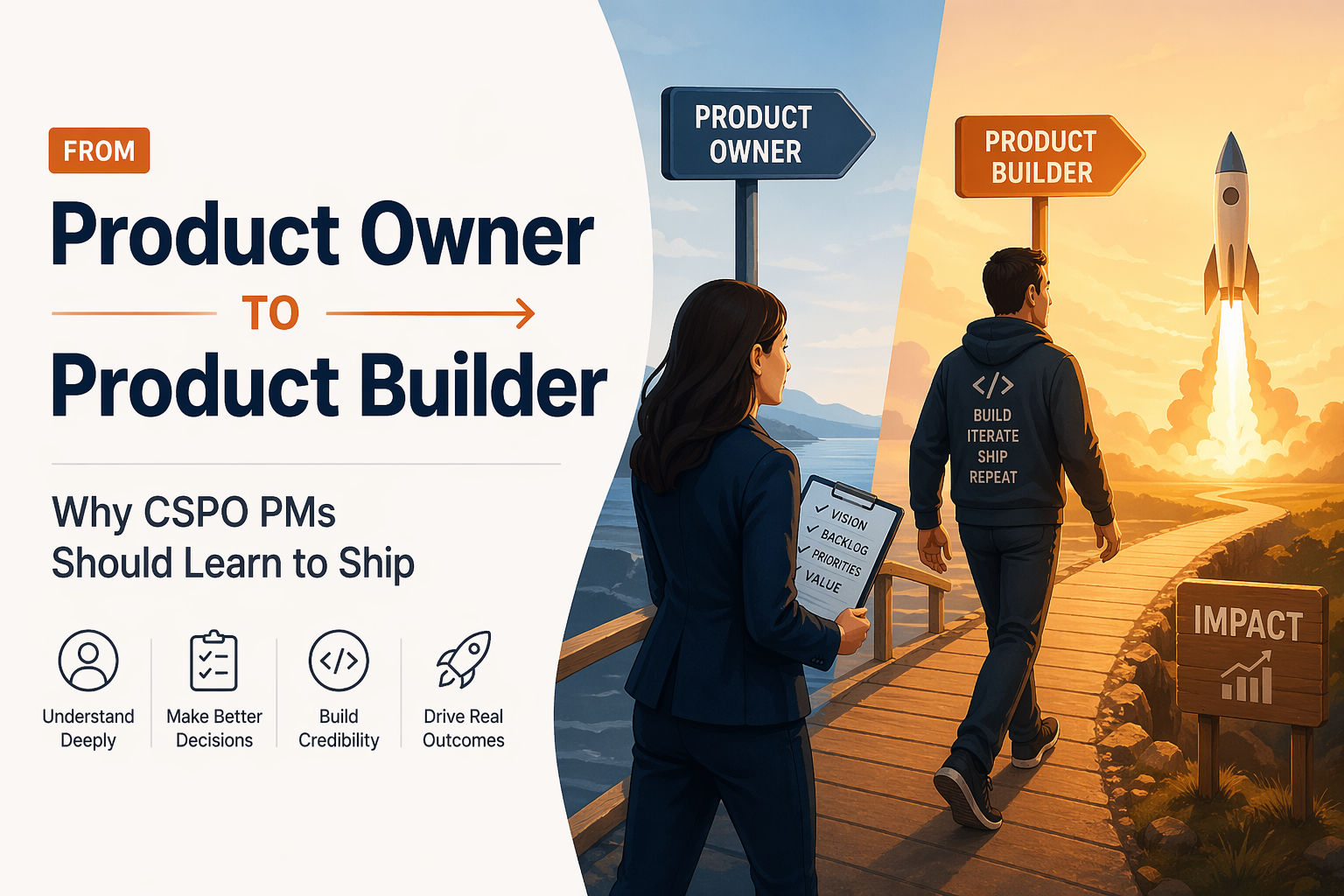
From Product Owner to Product Builder: Why CSPO PMs Should Learn to Ship
30-second summary available
The CSPO certification taught me to own the product. Building taught me to understand the product. Here's the transition path, what I built, and why every PO should learn to ship.
For three years, my job was to own the backlog. Refine user stories. Write acceptance criteria. Prioritise features. Sit in sprint planning. Review what engineering built. Approve or reject. Repeat. I was good at it. I had a CSPO certification, happy stakeholders, and a roadmap that everyone trusted. But I never shipped anything myself. Every idea I had went through a chain of translation — from my head, to a spec, to a designer, to an engineer, to code, to production. By the time it arrived, it barely resembled what I'd imagined. Then I started building.
The traditional Product Owner role — backlog management, stakeholder alignment, sprint facilitation — is being compressed by AI. What's expanding is the expectation that POs and PMs can validate ideas independently, prototype features in hours, and show working software instead of slide decks. This post is the story of how I made that transition, what I learned, and why I think every CSPO PM should learn to ship.
In This Post
- The CSPO ceiling: what certification taught me and what it didn't
- The moment that changed my approach
- What "learning to ship" actually looks like for a PM
- The five things I built that changed my career
- What building taught me that managing never could
- The Product Owner vs Product Builder comparison
- The honest risks of the builder path
- How to start: from CSPO to builder in 90 days
- The bottom line
The CSPO Ceiling
Let me be clear: the CSPO certification was valuable. It gave me a structured understanding of Scrum Alliance's product ownership framework — vision articulation, backlog management, stakeholder alignment, sprint facilitation, and value maximisation. Those frameworks aren't outdated. They're still the foundation of good product work.
But here's what certification didn't teach me:
How to validate an idea in an afternoon. CSPO teaches you to write user stories and acceptance criteria. It doesn't teach you how to turn that story into a testable prototype before committing engineering resources. So every validation cycle took weeks — write the story, wait for design, wait for engineering, launch, measure. By the time you learned whether the idea worked, you'd invested a full sprint.
How to communicate through building. The best spec I ever wrote still got misinterpreted by engineering. The best wireframe I ever created still surprised stakeholders when it became real software. Words and mockups are lossy compression formats for product ideas. Working software is not.
How the product actually works. I could describe what the product should do. I couldn't explain how the database handled concurrent writes, why a serverless function timed out, or what Row-Level Security meant for multi-tenant data access. This knowledge gap didn't just affect technical conversations — it affected product decisions. I was making architecture-blind roadmap choices.
How to be useful when there's no engineering bandwidth. In every product team I've worked on, engineering was the bottleneck. Not because engineers were slow — because there was always more to build than people to build it. As a traditional PO, when engineering was at capacity, I was stuck writing specs for features that wouldn't start for months. I was planning, not doing.
| What CSPO Teaches Well | What CSPO Doesn't Teach |
|---|---|
| Product vision and strategy | How to validate ideas before committing sprints |
| Backlog management and refinement | How to prototype without engineering |
| User story writing and acceptance criteria | How the underlying technology actually works |
| Stakeholder alignment | How to communicate through working software |
| Sprint planning and review | How to be productive when engineering is at capacity |
| Value maximisation frameworks | How to build independently when resources are scarce |
The Moment That Changed My Approach
It wasn't a single moment. It was a pattern I kept seeing across enterprise clients.
I was working on an Order Management System for a UAE-based client. We had a complex requirement — orders arriving via email, WhatsApp, and a web portal, each with different document formats including Arabic-English purchase orders and handwritten scans. I wrote what I considered a thorough spec: 10 customer PO types, trigger keywords for each channel, document format handling, approval workflows.
Engineering spent two weeks building it. When the first demo happened, the client said: "This isn't what we meant." The email parsing worked differently than they expected. The WhatsApp trigger flow didn't match their actual process. The approval chain was in the wrong order.
Two weeks of engineering time. A spec that I was proud of. And it still wasn't right.
That same month, I saw a Product Manager at a conference demo a feature she'd built in 90 minutes using an AI tool. It wasn't production-ready — but it was good enough to show to her client and get real feedback before a single engineer touched it. The client pointed to the screen and said "this part is right, this part is wrong, and we need something like this over here." In 90 minutes of building plus 20 minutes of feedback, she had clarity that I'd failed to achieve in two weeks of specifying and building.
That's when I started learning to build.
What Learning to Ship Actually Looks Like
I want to be honest about this: learning to build as a PM is not the same as learning to be an engineer. The goal isn't to write production code. The goal is to create working prototypes that communicate your product vision clearly enough to validate ideas and align teams.
Here's what the learning path actually looked like for me:
Phase 1: AI Prototyping Tools (Week 1-4)
I started with Claude Artifacts. Describe a feature in plain English, get an interactive React component in 60 seconds. No setup. No IDE. No configuration. Just conversation.
My first prototype was embarrassingly simple — a table that filtered purchase orders by status. But when I showed it to my engineering team, something changed. They stopped asking me to clarify the spec and started suggesting improvements to the interaction. The prototype became the conversation.
Then I moved to Lovable. Full-stack apps with Supabase backends, real authentication, and deployment. My first Lovable prototype was a CRM pipeline view for an EdTech sales team. It took 90 minutes. The team used it for a week before engineering rebuilt it properly.
Phase 2: Understanding the Stack (Month 2-3)
This is the phase most "PM who builds" content skips. Prototyping with AI tools is easy. Understanding why the prototype works — and why it would break at scale — is where real product knowledge lives.
I learned what a Supabase database actually does. How tables relate to each other. What indexes do and why missing them makes everything slow. How Row-Level Security controls who sees what data. How connection pooling prevents your app from crashing under load.
I didn't learn this from a course. I learned it by building things that broke and then figuring out why.
Phase 3: Building for Real Users (Month 3-6)
The transition from "prototype for demos" to "prototype for validation" happened when I started sharing my builds with actual users — not stakeholders, not team members, but the people who would use the product.
A Floor Planning Builder for warehouse layout management. A Lease Management dashboard. A P2P lending prototype. A Clinic Management system. An EdTech Sales CRM. Each one started as a vibe-coded prototype. Some became real products. Others died after user testing revealed the idea wasn't worth pursuing. Both outcomes were valuable — and both happened in days instead of months.
Five Things I Built That Changed My Career
These aren't my best prototypes. They're the ones that taught me the most.
| What I Built | Tool Used | What It Taught Me |
|---|---|---|
| Lease Management Dashboard | Lovable + Supabase | Database schema design matters more than UI design for data-heavy products |
| P2P Lending Prototype | Claude Artifacts | User feedback on a 90-minute prototype killed a feature idea that would have taken 3 months to build |
| EdTech Sales CRM | Lovable + Supabase | Multi-role access control is the hardest thing to get right — and the first thing to break |
| Floor Planning Builder | Bolt.new | Spatial interfaces need fundamentally different interaction patterns than form-based interfaces |
| WhatsApp Order Processing Bot | Claude Code + Supabase | Integration-heavy products can't be fully prototyped — you need a real system to test the edge cases |
The pattern across all five: the things I learned by building were things no spec, wireframe, or user story could have taught me. The database decisions. The performance tradeoffs. The interaction patterns that feel obvious in theory and break in practice.
What Building Taught Me That Managing Never Could
1. Empathy for Engineering Is Real When You've Built
Before I built, I'd push back on engineering estimates: "Why does this take two sprints? The spec seems straightforward." After I built, I stopped asking that question. I know why it takes two sprints. Because the spec is never straightforward once you start implementing it. Edge cases emerge. Database decisions compound. Authentication flows have 15 states, not the 3 you drew on the whiteboard.
I'm a better product partner to engineering now — not because I can code like them, but because I understand the territory they work in.
2. Product Decisions Improve When You Understand the Stack
When I know that adding a feature requires a new database table with complex relationships, I weigh that cost differently than when I only see it as a line item on a roadmap. When I know that a "simple filter" actually requires an index on a column that handles 100,000 rows, I make different prioritisation decisions.
Stack knowledge doesn't make you an engineer. It makes you a PM who doesn't accidentally create expensive features by being architecture-blind.
3. Speed to Learning Is the Real Superpower
The biggest advantage of being a PM who builds isn't the prototype itself. It's the speed at which you learn whether an idea is worth pursuing. A traditional PO learns whether a feature works after it ships — weeks or months later. A PM who builds learns in an afternoon.
As LogRocket's analysis puts it: the person closest to the problem can now build solutions without waiting on anyone else. The shift is from authority-based influence to capability-based influence.
4. Your Portfolio Changes the Job Conversation
When I apply for PM roles, I don't just describe what I managed. I show what I built. A working prototype communicates product sense in a way that a resume bullet point never can. In AI PM interviews, candidates who demo a working prototype consistently outperform candidates who only describe one.
Product Owner vs Product Builder
Here's the honest comparison between the traditional CSPO Product Owner role and the emerging Product Builder role:
| Dimension | Traditional Product Owner | Product Builder |
|---|---|---|
| Core skill | Backlog management, stakeholder alignment | Prototyping, validation, strategic building |
| How ideas are communicated | Specs, user stories, wireframes | Working prototypes and demos |
| Validation cycle | 2-4 weeks (write spec → design → build → test) | 1-2 days (prototype → user test → decide) |
| Engineering relationship | Directive — "here's what to build" | Collaborative — "here's what works, let's make it production-ready" |
| Influence model | Authority-based — roadmap ownership | Capability-based — demonstrated output |
| When engineering is busy | Writes more specs and waits | Builds and validates independently |
| Technical understanding | Conceptual — knows what the product does | Structural — knows how the product works |
| Career differentiator | Process expertise, stakeholder management | Shipped products, portfolio of builds |
Important caveat: This is not an either/or. The best PMs I know are strong on both sides — they can manage a complex stakeholder landscape AND prototype a feature in an afternoon. The builder skills don't replace the owner skills. They amplify them.
The Honest Risks
I'd be dishonest if I didn't mention where this path gets dangerous:
Building becomes procrastination. The dopamine hit of "I made a thing" is more immediate than the slow grind of customer discovery and strategic analysis. I've caught myself prototyping features when I should have been talking to users. If you're building to avoid the harder work, you're doing it wrong.
Overconfidence in your prototypes. A prototype that works for 5 users is not production software. I've had to learn — sometimes painfully — that my vibe-coded builds need security review, performance testing, and architectural oversight before they go anywhere near real users at scale.
Neglecting the PO fundamentals. Backlog management, stakeholder alignment, and sprint facilitation still matter. Especially in enterprise environments. A PM who can prototype but can't manage a roadmap isn't a Product Builder — they're a developer with extra context.
The time balance. I follow a strict rule: prototype time should not exceed what I used to spend on wireframing. 60-90 minutes per feature concept. Not half the week. The rest of the time belongs to discovery, strategy, and the relational work that only a PM can do.
How to Start: From CSPO to Builder in 90 Days
Here's the practical path I'd recommend to any CSPO PM who wants to add building to their toolkit.
| Week | Focus | Action | Tool |
|---|---|---|---|
| 1-2 | First prototype | Build one feature idea in Claude Artifacts — describe it in plain English, iterate 3-5 times | Claude Artifacts |
| 3-4 | Full-stack prototype | Build an app with a real database and auth — pick a problem you know deeply from your domain | Lovable + Supabase |
| 5-6 | User validation | Share your prototype with 5 real users — watch them use it, collect feedback, iterate | Your prototype + video calls |
| 7-8 | Stack understanding | Learn what your prototype does under the hood — database schema, auth flow, API structure | Supabase docs, Claude explanations |
| 9-10 | Build for your team | Prototype a feature your actual product team is considering — show it in sprint planning | Lovable or Claude Artifacts |
| 11-12 | Ship and reflect | Hand off a validated prototype to engineering for production — document what you learned | Notion for docs, Cursor for handoff |
By the end of 90 days, you should be able to:
- Prototype a feature concept in 60-90 minutes
- Explain what a database, server, auth flow, and storage layer do in your product
- Validate an idea with real users before committing engineering resources
- Show a working prototype in sprint planning instead of a slide deck
- Have an informed architectural conversation with your engineering team
The Bottom Line
The CSPO certification taught me to own the product. Building taught me to understand the product. Both matter. Neither is sufficient alone.
The product management role is evolving from "person who manages what gets built" to "person who can independently validate, prototype, and ship ideas." This doesn't mean PMs replace engineers. It means PMs contribute through execution, not just direction. The influence model shifts from "I own the roadmap" to "I built the prototype that proved this was worth building."
Every CSPO PM already has the hardest skill: understanding what users need and translating that into product decisions. What's new is the ability to close the gap between "I know what to build" and "here's a working version" in hours instead of weeks.
The PMs who learn to ship won't replace the PMs who manage well. But they'll consistently move faster, learn faster, and get more resources — because working software is the most persuasive artefact in any product organisation.
Related reading on this blog: The AI Product Manager Roadmap 2026: Skills, Tools, and Career Path · Product Managers Who Vibe Code: Why PMs Should Build Their Own Prototypes · How I Use AI as a Product Manager: My Daily Workflow