The AI Product Manager Roadmap 2026: Skills, Tools, and Career Path
30-second summary available
The PM role is being rewritten. Here's the skill stack, tool kit, career ladder, and 12-month roadmap for becoming an AI Product Manager — from a CSPO PM who actually builds.
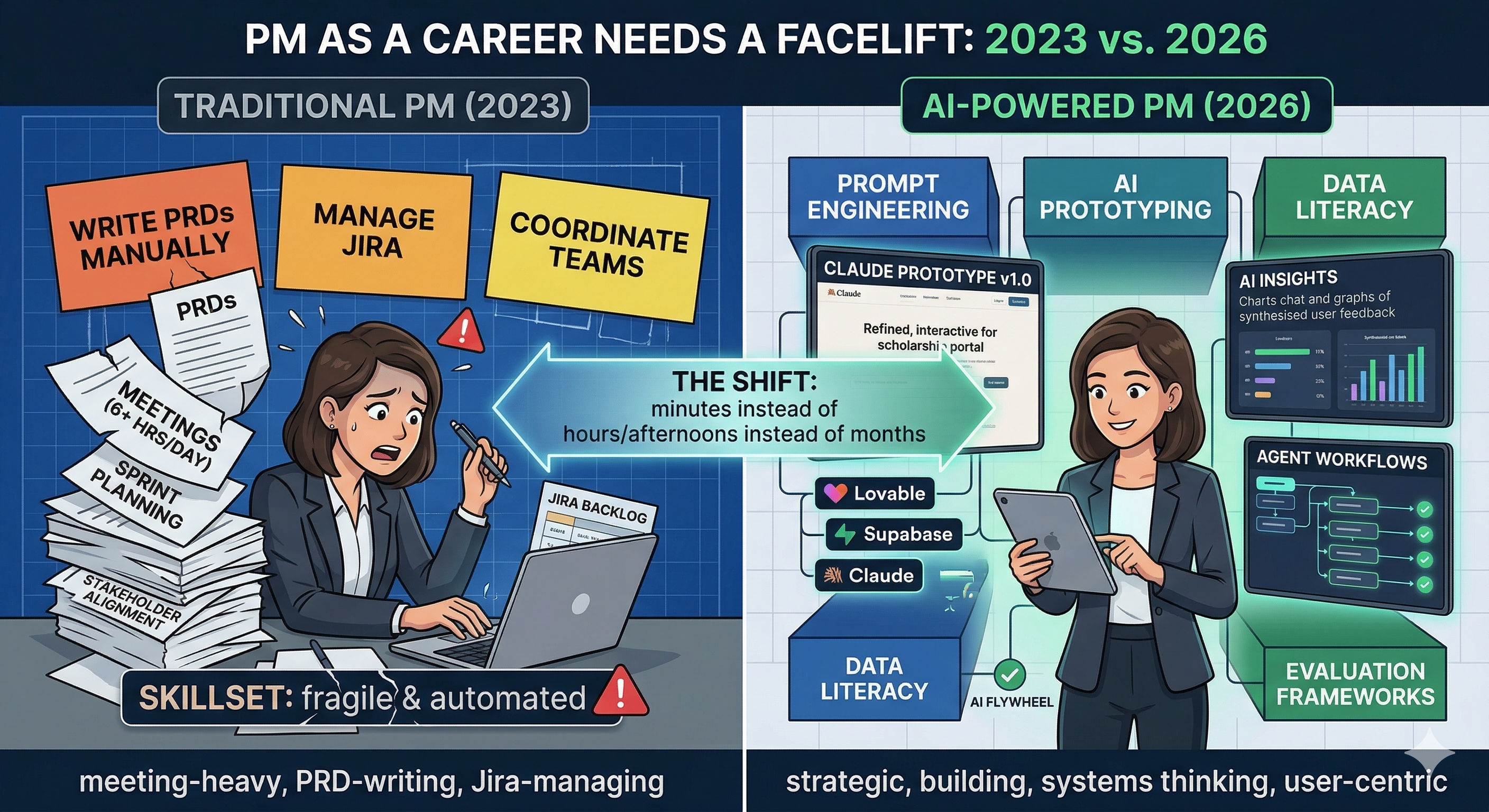
If your PM skillset in 2026 is "I know how to write a Jira ticket and send a prompt to ChatGPT," your career is fragile. Companies like Google are moving PMs into technical staff groups. Hiring managers expect you to vibe-code an MVP in an afternoon. AI is automating the documentation, the reporting, and the basic analysis that used to justify half your calendar. The question isn't whether PM is changing. It's whether you're changing fast enough.
The hook: There are 14,000+ AI Product Manager job openings globally. US salaries range from $133K to $200K+. But the role that existed in 2023 — the meeting-heavy, Jira-managing, PRD-writing PM — is being replaced by something fundamentally different. This post maps what that new role looks like, what skills it requires, and how to get there from where you are now.
In This Post
- Why PM is being rewritten in 2026
- The three types of PM in the AI era
- The AI PM skill stack: what actually matters
- The tools that AI PMs actually use
- The career path: from traditional PM to AI PM
- The 12-month roadmap: how to get there
- What makes this roadmap different from the generic ones
- The bottom line
Why PM Is Being Rewritten in 2026
The product management role that most of us learned — discovery calls, PRDs, sprint planning, stakeholder alignment, feature prioritisation — isn't disappearing. But it's being compressed. AI tools can now draft product roadmaps, summarise user research, generate PRDs, and create initial design mockups in minutes. The administrative layer of PM work — the part that used to fill 40+ hours a week — is being automated faster than most PMs realise.
What remains, and what's growing in importance, is the strategic layer: understanding user problems deeply enough to know which ones AI can solve, designing systems that learn and improve over time, and making product decisions under uncertainty. Traditional PMs worked with deterministic software — if you build this feature, it works this way every time. AI PMs work with probabilistic systems — your chatbot gives a brilliant answer 95% of the time and hallucinates 5% of the time. Managing that uncertainty is the entire job.
Here's what's shifted:
| What PMs Did in 2023 | What AI PMs Do in 2026 |
|---|---|
| Write PRDs manually | Use Claude/GPT to draft PRDs, then edit for strategy and nuance |
| Manage Jira backlogs | Define AI agent workflows that auto-triage and prioritise |
| Sit in 6 hours of meetings per day | Spend that time prototyping and validating with real users |
| Hand wireframes to engineering | Vibe-code working prototypes in Claude Artifacts or Lovable |
| Analyse dashboards for metrics | Use AI to synthesise feedback at scale and surface insights |
| Wait 3 months for an MVP | Ship a testable prototype in an afternoon |
| Coordinate cross-functional teams | Orchestrate human-agent collaboration inside products |
The PM as a career needs a facelift. The PMs who thrive in 2026 aren't the ones who manage better. They're the ones who build, think in systems, and understand how AI actually works — not at a PhD level, but well enough to make good product decisions.
The Three Types of PM in the AI Era
Not every PM needs to become a machine learning expert. But every PM needs to understand where they sit on the AI competency spectrum. Product School frames this as three buckets:
| PM Type | What They Do | Career Outlook |
|---|---|---|
| Traditional PM | Classic PM toolkit — PRDs, roadmaps, stakeholder management. No AI integration in workflow. | Fading fast. This role is being automated or compressed. |
| AI-Powered PM | Uses AI tools to do PM work faster — drafting specs, analysing feedback, prototyping, research synthesis. Doesn't build AI features, but uses AI daily. | Strong demand. This is the minimum viable PM in 2026. |
| AI Product Manager | Builds AI-driven products or features. Understands model behaviour, data pipelines, evaluation metrics, and agent architectures. | Highest demand, highest salaries ($133K-$200K+ in the US). |
I sit in the overlap between the second and third categories. I'm a CSPO-certified Product Consultant who uses AI tools daily for prototyping, specification writing, and workflow automation. I also build AI-powered features — like the SKU Matching system and the WhatsApp Order Bot I designed for enterprise clients. I don't write production machine learning code, but I understand the systems well enough to make architectural decisions and evaluate whether AI output is good enough to ship.
That overlap — the PM who builds — is where I think the most career value sits in 2026. Not the PM who only manages. Not the ML engineer who doesn't think about users. The person who does both, even if imperfectly.
The AI PM Skill Stack
Here's the skill stack that actually matters, organised by what I use daily versus what I've learned to understand conceptually. This isn't a theoretical framework — it's what my work actually requires.
Tier 1: Non-Negotiable (Use These Daily)
Prompt engineering. This is the new literacy for PMs. Not "write a good ChatGPT prompt" — that's table stakes. Real prompt engineering means understanding how to structure context for Claude or GPT to produce consistent, high-quality output for product work: spec generation, user story drafting, competitive analysis, feedback synthesis. The difference between a PM who prompts well and one who prompts poorly is the difference between a 10-minute PRD and a 2-hour PRD.
Prototyping with AI. The ability to turn a product idea into a clickable, testable prototype without waiting for engineering. Claude Artifacts generates interactive React components in under 60 seconds. Lovable builds full-stack apps from natural language. When you can show an engineer a working prototype instead of a Jira ticket, everything changes — velocity, respect, and the quality of the conversation.
Data literacy. Not data science — data literacy. Can you read a SQL query and understand what it returns? Can you look at a conversion funnel and identify where users drop off? Can you evaluate whether a metric is actually measuring what you think it's measuring? Experienced AI PMs on Reddit consistently say data literacy matters more than coding ability.
Product strategy under uncertainty. Traditional PM: "If we build this feature, users will do X." AI PM: "If we train this model on this data, users will probably do X about 85% of the time, and we need to design for the 15% where it doesn't work." This mindset shift — from deterministic to probabilistic — is the fundamental difference.
Tier 2: Important (Use These Weekly)
AI/ML fundamentals. You don't need to build a neural network. But you need to know the difference between supervised and unsupervised learning, what a training dataset is, why models hallucinate, and what "fine-tuning" means versus "prompting." This knowledge lets you have productive conversations with your engineering team instead of nodding along to words you don't understand.
Evaluation and metrics for AI features. Traditional features: did the user complete the task? AI features: how accurate was the output? How often did it hallucinate? What's the latency? What's the cost per inference? Is the model biased? AI PMs need to define evaluation frameworks that measure quality beyond "does it work."
Systems thinking. AI products aren't isolated features. They're ecosystems — user interactions generate data, data improves models, better models improve interactions. This is the AI flywheel, and understanding it is what separates a PM who adds AI features from a PM who builds AI-native products.
Understanding agentic AI. AI agents — systems that plan, execute multi-step tasks, use tools, and achieve goals autonomously — are the next layer of AI product development. PMs need to understand how agents work, what guardrails they need, and how to design human-agent collaboration. This is emerging territory, but it's where enterprise product development is heading fast.
Tier 3: Valuable (Learn These Over Time)
RAG (Retrieval-Augmented Generation) architecture. How do you make an AI product answer questions using your company's specific data? RAG is the answer, and understanding it lets you scope AI features that are grounded in real information instead of model hallucinations.
Basic API and integration understanding. How do AI services connect to your product? What's a webhook? What's an API rate limit? You don't need to build these, but you need to know what's possible and what constrains your product decisions.
AI ethics and responsible AI. Bias in training data, fairness in model outputs, transparency in AI decision-making. These aren't abstract concerns — they're product requirements that affect real users. The NIST AI Risk Management Framework is a good starting point.
| Skill | Why It Matters | How to Learn It |
|---|---|---|
| Prompt engineering | Speeds up every PM task — specs, research, analysis | Practice daily with Claude/GPT for real work output |
| AI prototyping | Ship ideas without engineering dependency | Build 3 prototypes in Claude Artifacts this week |
| Data literacy | Make evidence-based decisions, not opinion-based | Learn basic SQL, practice reading dashboards and funnels |
| AI/ML fundamentals | Talk productively with engineering teams | Andrew Ng's "AI for Everyone" (3 hours, free on Coursera) |
| Evaluation frameworks | Measure AI feature quality beyond "does it work" | Define accuracy, latency, cost, and bias metrics for one feature |
| Systems thinking | Design products with compounding data advantages | Map your product's AI flywheel on a whiteboard |
| Agentic AI understanding | Prepare for the next wave of AI product development | Read about MCP, SAP Joule, and Salesforce Agentforce architectures |
| RAG architecture | Scope AI features grounded in company data | Build one RAG prototype using Claude or a simple vector database |
| Responsible AI | Ship AI features that are fair, transparent, and compliant | Review NIST AI RMF and OWASP Top 10 for LLM Applications |
The Tools That AI PMs Actually Use
Here's my actual tool stack. Not a vendor-sponsored list — the tools I open every day.
| Tool | What I Use It For | Category |
|---|---|---|
| Claude | PRD drafting, product thinking, research synthesis, prototyping via Artifacts | AI Assistant |
| Claude Code | Building production features, debugging, codebase-level AI assistance | AI Development |
| Cursor | In-editor AI coding for when I need to work inside the codebase | AI IDE |
| Lovable | Full-stack MVP prototyping with design quality | Vibe Coding |
| Notion | Product specs, documentation, roadmap management | PM Documentation |
| Supabase | Backend — database, auth, storage, real-time | Backend Platform |
| Figma | Design review, Figma Slides for presentations | Design |
| Apollo.io | B2B outreach, lead sourcing for client work | Sales/GTM |
| Vercel | Frontend deployment | Hosting |
| Gamma | Presentations and visual storytelling | Presentations |
| Google AI Studio | Quick AI prototyping and experimentation | AI Prototyping |
The key insight: the tools are converging. Claude is my thinking partner, my spec writer, my prototyper, and my code reviewer. Supabase is my database, my auth system, my file storage, and my API layer. The PM who knows five tools deeply beats the PM who knows twenty tools superficially.
The Career Path
The AI PM career path isn't a straight line — it's a transition from adjacent roles. Based on what I've seen in my own career and in the market:
| Where You Start | Transition Path | Timeline |
|---|---|---|
| Traditional PM / PO | Learn AI fundamentals + start prototyping with AI tools + take on one AI-adjacent feature | 6-12 months |
| Software Developer | Learn product strategy + user research + stakeholder management + apply technical depth to AI products | 6-12 months |
| Data Analyst / Data Scientist | Learn product management frameworks + user empathy + roadmapping + use data skills as your AI advantage | 3-6 months |
| UX Designer | Learn AI interaction patterns + prototyping with vibe coding tools + understand model limitations for UX | 6-12 months |
| Business Analyst | Learn AI fundamentals + data literacy + start building proof of concepts | 9-12 months |
The career ladder once you're in AI PM:
| Level | Role | Focus | Typical Experience |
|---|---|---|---|
| Entry | Associate PM / Product Owner | Learn AI product basics, assist senior PMs, own small features | 0-2 years |
| Mid | AI Product Manager | Own an AI product or feature end-to-end, define metrics, work with ML teams | 2-5 years |
| Senior | Senior AI PM / Group PM | Own product strategy, lead multiple AI features, influence roadmap | 5-8 years |
| Leadership | Director / VP of Product | Define AI product vision, build and lead PM teams, set company AI strategy | 8+ years |
The 12-Month Roadmap
Here's how I'd structure the transition if I were starting today. This is based on what Product School recommends, adapted with what I've actually found useful.
Months 1-3: Build the Foundation
Learn AI fundamentals. Take Andrew Ng's "AI for Everyone" on Coursera — it's 3 hours and free. Understand training data, inference, bias, and the basic ML lifecycle. You're not becoming a data scientist. You're becoming a PM who can have an informed conversation about AI.
Start prototyping. Open Claude and build three artifacts this week. Describe a feature idea, let Claude generate a prototype, iterate through conversation. This single habit — prototyping instead of writing specs — will change how you think about product development. Then try Lovable for a full-stack prototype with a real backend.
Improve your prompting. Use Claude for every PM task for one month: user story generation, competitive analysis, spec drafting, meeting summaries. Pay attention to what produces good output and what doesn't. Refine your prompts until you can generate a solid first draft of any PM document in under 5 minutes.
Months 4-6: Get Hands-On
Build a real project. Pick a problem you understand deeply — something from your domain expertise — and build a working AI-powered solution. Not a toy. Something a real user could test. Use Supabase for the backend, React for the frontend, and Claude Code for the development assistance.
Learn to evaluate AI output. For your project, define a simple evaluation framework. How often does the AI give the right answer? What's the failure mode? How do users react to incorrect output? This practice — systematically evaluating AI quality — is the skill that separates junior from senior AI PMs.
Study agentic AI. Read about MCP (Model Context Protocol), how SAP Joule agents work, and how Salesforce Agentforce is being deployed. Understand the difference between a chatbot, a copilot, and an autonomous agent. This is where enterprise product development is heading.
Months 7-9: Lead an Initiative
Take ownership of an AI feature. At your company, identify one workflow that could benefit from AI and propose a solution. Scope it, prototype it, present it. You don't need permission to prototype — build it in Claude Artifacts and show it to your team. The PM who shows a working prototype gets more buy-in than the PM who shows a slide deck.
Start sharing what you learn. Write about your AI PM journey. Host a lunch-and-learn. Post on LinkedIn. Teaching deepens understanding, and visibility builds your personal brand in the AI PM space.
Months 10-12: Level Up
Build your AI product strategy muscle. For your product or company, write an AI strategy document: where AI adds value, where it doesn't, what data you need, what risks exist, and what the 12-month roadmap looks like. This is the artefact that demonstrates senior-level AI PM thinking.
Prepare for AI PM interviews. AI PM interviews are harder than traditional PM interviews. They include questions like "How would you measure the success of GPT-5?" and "Design an AI feature that increases DAU by 10%." Practice framing answers that combine user empathy, technical understanding, and business impact.
Refine your AI flywheel. For every product you work on, be able to articulate: how user interactions generate data, how that data improves the model, and how the improved model drives better user outcomes. If you can draw this loop on a whiteboard and explain each step, you have an AI product strategy — not just an AI feature.
What Makes This Different
Most AI PM roadmap articles are written by course sellers, career coaches, or people who haven't actually built AI products. They tell you to "learn TensorFlow" and "get an AI certification." That's like telling someone who wants to be a chef to study food chemistry — technically relevant but practically useless for day one.
This roadmap is different because it's built from what I actually do as a PM who ships products:
- Prototyping beats certification. Building three Claude Artifacts teaches you more about AI product development than any 6-week course.
- Domain expertise is your moat. A PM who understands school lab management and can vibe-code a prototype is more valuable than a PM with an AI certificate who doesn't understand the problem.
- Tools mastery beats theory. Knowing how to use Claude, Supabase, and Lovable effectively is more immediately career-useful than understanding backpropagation.
- The PM who builds gets the job. In every AI PM interview I've studied, the candidates who can show a working prototype outperform the candidates who can only describe one.
The Bottom Line
The AI Product Manager role in 2026 isn't a new job title — it's the evolution of what product management has always been. PMs have always translated between business needs and technical capabilities. The technical capabilities have just gotten dramatically more powerful, more complex, and more probabilistic.
The PMs who thrive won't be the ones who memorise AI frameworks or chase every new model release. They'll be the ones who stay curious, build constantly, understand their users deeply, and know enough about AI to make good decisions — not enough to build the models themselves, but enough to know when the model is wrong and what to do about it.
The role isn't fully defined yet. That's not a risk — it's the opportunity. The PMs who define what this role becomes will be the ones who started building while everyone else was still reading about it.
Related reading on this blog: Anyone Can Vibe Code. But Can Anyone Build Software That Scales? · How to Use Claude to Build a Prototype and Iterate Into a Solid MVP · Trending AI Tools for Vibe Coding: From Prototype to Production-Ready