AI Is Replacing PM Busywork, Not PMs: What Product Managers Should Actually Worry About
30-second summary available
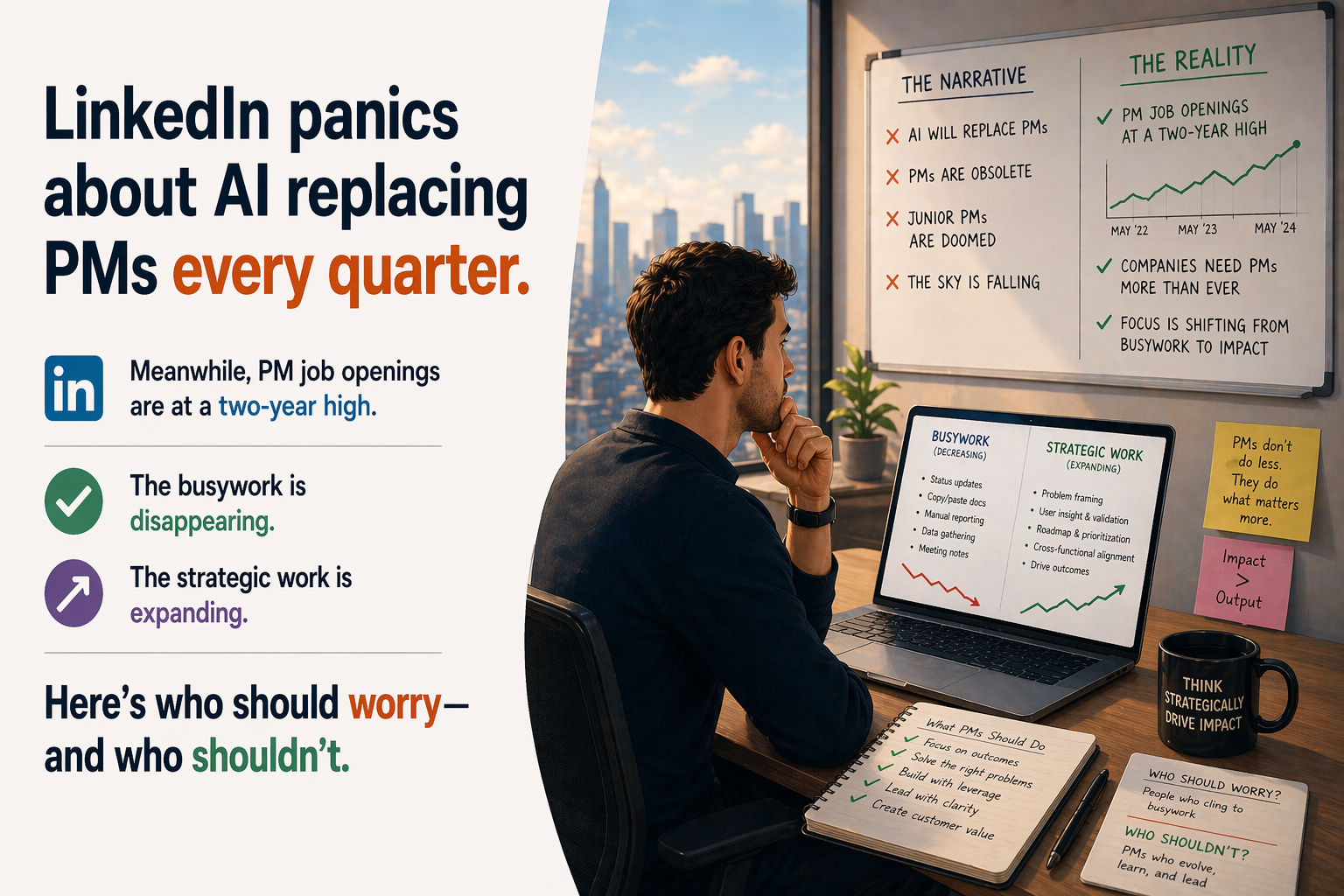
LinkedIn panics about AI replacing PMs every quarter. Meanwhile, PM job openings are at a two-year high. The busywork is disappearing. The strategic work is expanding. Here's who should worry — and who shouldn't.
Every quarter, LinkedIn panics about AI replacing Product Managers. The headlines write themselves: "PMs Are Obsolete," "AI Can Do 80% of Your Job," "The End of Product Management." Meanwhile, PM job openings hit 6,000+ globally — the highest in over two years. Demand is growing in SaaS, fintech, AI, and enterprise software. So which is it — extinction or expansion? Neither. The truth is more specific, more useful, and more uncomfortable than either narrative suggests.
AI can now draft PRDs in 5 minutes, summarise 200 user interviews in 30 seconds, generate competitive analyses, mock up wireframes, and suggest OKRs. That's real. McKinsey estimates AI agents could handle tasks representing 44% of US work hours. That's also real. But 95% of generative AI initiatives fail to generate meaningful financial returns. The busywork is disappearing. The strategic work is expanding. And the PMs in the middle — the ones whose value was process, not insight — are the ones who should worry.
In This Post
- The panic is wrong. The complacency is also wrong.
- What AI actually automates in PM work today
- What AI cannot do (and won't for a long time)
- The PM work that's disappearing vs expanding
- The uncomfortable middle: which PMs are actually at risk
- The five skills that become more valuable, not less
- How I've restructured my own PM work around AI
- The career action plan: what to do this quarter
- The bottom line
The Panic Is Wrong
Let's start with what's actually happening in the job market.
PM demand isn't shrinking — it's growing. Product School reports that there were over 6,000 open PM roles globally in 2025, the most in over two years. McKinsey's 2024 global AI report found that while 43% of companies report productivity gains from AI, only 11% have realised measurable ROI at scale. Demand for AI fluency in job postings has grown nearly sevenfold in two years — but that demand is for PMs who use AI, not for AI that replaces PMs.
The ATM analogy is useful here. When ATMs arrived, everyone predicted the end of bank tellers. Instead, ATMs made branches cheaper to operate, banks opened more branches, and the number of bank tellers actually grew. But the job changed — from counting cash to relationship banking. The same pattern is emerging in PM: AI automates the transaction work, and the role shifts toward relationship and strategy work that humans do better.
The complacency is also wrong. The PM who says "AI can't do what I do" without examining which parts of their job are already automatable is making the same mistake as the bank teller who thought counting cash was the valuable part. If your daily work is mostly documentation, reporting, and ticket management, the threat is real — not because AI replaces you, but because a PM who uses AI does your job in half the time.
What AI Actually Automates in PM Work Today
Here's an honest assessment of what AI handles well right now — not in theory, not in demos, but in daily PM practice:
| PM Task | AI Capability | Quality Level | Time Saved |
|---|---|---|---|
| Writing PRD first drafts | Claude/GPT generates full specs from context | 70% quality — needs PM editing for strategy and nuance | 2 hours → 20 minutes |
| User feedback synthesis | Analyses 100+ interviews and surfaces themes | 80% quality — catches patterns humans miss, misses context humans catch | 4 hours → 30 minutes |
| Competitive analysis | Researches competitors, structures comparisons | 65% quality — good framework, needs PM judgement on strategic positioning | Half a day → 45 minutes |
| Status reports | Generates weekly updates from project data | 85% quality — factual and structured, needs tone adjustment | 30 minutes → 5 minutes |
| User story writing | Drafts stories with acceptance criteria | 75% quality — technically sound, often misses edge cases and user context | 20 min per story → 3 min per story |
| Data analysis | Summarises dashboards, identifies anomalies | 70% quality — finds patterns, needs PM to interpret business meaning | 2 hours → 20 minutes |
| Meeting summaries | Transcribes and extracts action items | 90% quality — nearly production-ready | 15 minutes → 1 minute |
| Wireframe generation | Produces low-fidelity mockups from descriptions | 50% quality — good for throwaway exploration, not for design handoff | 1 hour → 10 minutes |
The pattern: AI handles the 70% of PM work that is structured, repeatable, and data-processing. It produces a good first draft — fast. The PM handles the 30% that requires judgement, context, and strategy. That 30% is where the value lives.
As Lenny Rachitsky's experiment showed, when PM outputs from AI and humans were compared in blind tests, voters often couldn't tell the difference for structured tasks. But for strategic reasoning and nuanced trade-off decisions, the human PM consistently won.
What AI Cannot Do
This is the section that matters most. Here's what AI cannot do in PM work today, and why these capabilities aren't arriving anytime soon:
Frame the right problem. AI can analyse data. It cannot decide which data matters. A PM's most valuable skill is looking at a messy situation — conflicting user feedback, ambiguous metrics, competing stakeholder priorities — and deciding what the actual problem is. Problem framing is creative, contextual, and political. AI has none of these capabilities.
Make trade-offs under uncertainty. "Should we serve enterprise customers better or expand to mid-market?" "Should we ship this feature with known bugs or delay the launch?" "Should we invest in this unproven technology or optimise what we have?" These are judgement calls that depend on market context, company strategy, team capability, competitive dynamics, and risk tolerance. AI can generate a pros-and-cons list. It cannot make the decision.
Build trust with humans. The PM who gets a controversial roadmap decision approved does it through accumulated trust — a track record of good judgement, honest communication, and deep understanding of stakeholder concerns. AI can draft the email. It cannot build the relationship that makes the email persuasive.
Navigate organisational politics. Every product decision happens inside an organisation with competing interests, budget constraints, and interpersonal dynamics. The PM who knows that the VP of Sales will block any pricing change unless you frame it as a retention improvement — that knowledge isn't in any dataset.
Understand what users don't say. In every user interview I've conducted, the most valuable insight came from something the user almost said, hesitated about, or contradicted themselves on. AI can transcribe and summarise. It cannot read the pause.
| What AI Does Well | What Humans Do Better |
|---|---|
| Process large volumes of data | Interpret what the data means in context |
| Generate structured documents | Decide what should go in the document |
| Identify patterns across feedback | Understand why those patterns exist |
| Draft options for a decision | Make the decision and own the consequences |
| Summarise conversations | Read the room during the conversation |
| Generate ideas quickly | Judge which ideas are worth pursuing |
| Produce consistent output | Produce creative output that challenges assumptions |
The PM Work That's Disappearing vs Expanding
Here's the honest picture — mapped to actual PM activities, not abstract skill categories:
| PM Activity | What's Happening | Impact on Your Time |
|---|---|---|
| PRD writing | Automated to first draft — you edit, not write from scratch | Shrinking from 6 hours/week to 1-2 hours/week |
| Status reporting | Fully automatable — AI generates from project data | Shrinking from 2 hours/week to 15 minutes/week |
| Feedback synthesis | AI handles volume, you handle interpretation | Shrinking from 4 hours/week to 1 hour/week |
| Competitive research | AI drafts, you validate and add strategic insight | Shrinking from 3 hours/sprint to 1 hour/sprint |
| Meeting prep and follow-up | AI summarises previous discussions, drafts agendas | Shrinking from 3 hours/week to 30 minutes/week |
| User interviews and discovery | Expanding — the time saved above goes here | Growing from 3 hours/week to 6+ hours/week |
| Strategic decision-making | Expanding — more time for the hard calls | Growing — with better data inputs from AI |
| Prototyping and validation | New — PMs can now build and test independently | New activity — 2-4 hours/week |
| AI feature design and governance | New — understanding how AI works inside your product | New activity — growing rapidly |
| Cross-functional leadership | Expanding — more alignment work as teams move faster | Growing — speed creates more coordination needs |
The net effect: The documentation layer of PM work is compressing. The strategy and discovery layers are expanding. And a new layer — prototyping, AI feature design, and agent governance — is emerging from scratch.
The Uncomfortable Middle
Here's the part most articles won't say: some PMs are at risk. Not because AI replaces the PM role, but because AI makes certain types of PM work unnecessary.
| PM Profile | Risk Level | Why |
|---|---|---|
| The "Jira Jockey" — spends most time managing tickets and tracking progress | High | AI automates ticket management, progress tracking, and status reporting |
| The "Spec Machine" — core value is producing detailed PRDs and documentation | High | AI produces first-draft specs faster and often at comparable quality |
| The "Meeting Broker" — value comes from sitting in meetings and relaying information between teams | High | AI summarisation and async tools reduce the need for information relay |
| The "Dashboard Reader" — analyses metrics and reports numbers to leadership | Medium | AI analysis is faster and often more comprehensive, but interpretation still needs a human |
| The "Strategist" — frames problems, makes trade-offs, builds product vision | Low | This work requires judgement, context, and trust that AI can't replicate |
| The "Builder PM" — prototypes, validates, and ships alongside engineering | Low | This PM uses AI as leverage, not competition |
| The "Discovery PM" — spends primary time with users, understanding problems deeply | Very Low | User relationships and qualitative insight are the hardest PM skills to automate |
The pattern: the more your daily work involves processing and documentation, the more vulnerable you are. The more your daily work involves judgement, relationships, and creative problem-solving, the more valuable you become.
This isn't theoretical. Claire Vo, CPO at LaunchDarkly, captures it directly: what used to take days to write now takes 15 minutes to scaffold and 45 minutes to sharpen. The PM who was valuable because they could write well is now competing with Claude. The PM who was valuable because they could think well is more valuable than ever.
The Five Skills That Become More Valuable
If AI handles the processing, these are the skills that earn your seat at the table:
1. Problem Framing
The ability to look at a messy situation and articulate: "This is the actual problem. This is who it affects. This is why it matters. This is how we'd know we'd solved it." AI cannot frame problems because framing requires choosing what to include and what to ignore — a creative and political act.
2. Decision-Making Under Uncertainty
Every consequential product decision involves incomplete information. "We think users want this, but we're not sure. We think this technology will work, but it might not. We think this market is big enough, but the data is ambiguous." The PM who can make a decision, own the outcome, and adjust based on what they learn is irreplaceable.
3. Stakeholder Influence
Getting a VP to change their mind about a feature priority. Convincing engineering to invest in infrastructure when the CEO wants visible features. Aligning three teams around a shared outcome when each has different incentives. This work is relational, political, and deeply human.
4. User Empathy at Depth
AI can synthesise what 200 users said. Only you can sit in a classroom in Bhubaneswar and watch a teacher struggle with lab equipment procurement and understand that the real problem isn't the software — it's that the teacher doesn't trust any digital system because the last three failed. That insight doesn't appear in transcripts.
5. AI-Informed Product Thinking
Understanding where AI adds genuine user value versus where it's a feature checkbox. Knowing when to use a deterministic workflow versus a probabilistic AI agent. Designing for the 5% failure rate that AI features inherently carry. This is an emerging skill that's scarce and increasingly valuable — Product School calls it the fastest-growing PM competency.
How I've Restructured My Own PM Work
Here's what my time allocation looked like before and after integrating AI into my workflow:
| Activity | Before AI (hours/week) | After AI (hours/week) | Where the Time Went |
|---|---|---|---|
| Spec writing and documentation | 8 | 2 | → User discovery |
| Meeting prep and follow-up | 4 | 1 | → Prototyping |
| Status reporting and updates | 2 | 0.25 | → Strategy work |
| Research and competitive analysis | 4 | 1 | → User discovery |
| User discovery and interviews | 4 | 8 | Doubled |
| Prototyping and validation | 0 | 4 | New |
| Strategy and roadmap thinking | 3 | 6 | Doubled |
| Stakeholder alignment | 3 | 3 | Unchanged |
Total productive hours stayed the same. But the mix shifted from 65% documentation and processing to 65% discovery, strategy, and building. That shift is the entire point.
The Career Action Plan
Here's what to do this quarter, regardless of where you are on the AI adoption curve:
| Week | Action | Why |
|---|---|---|
| Week 1 | Audit your time — track exactly how you spend every hour for one week | Know your current ratio of processing work vs judgement work |
| Week 2 | Pick the biggest time sink from your audit and find an AI tool for it | Start with the lowest-hanging fruit — probably status reports or meeting prep |
| Week 3 | Use Claude to draft your next PRD — time the difference | Experience the 70% first-draft quality and learn where your PM editing adds value |
| Week 4 | Build one prototype in Claude Artifacts | See what it feels like to communicate through building instead of through specs |
| Week 5-8 | Redirect every hour saved into user conversations | The time AI gives back is only valuable if you invest it in the work AI can't do |
| Week 9-12 | Define and practice your "irreplaceable" skills — problem framing, trade-off decisions, stakeholder influence | These skills atrophy if you only exercise them in rare planning meetings |
The PM who finishes this quarter with 50% more user conversations, one prototyping habit, and a clear understanding of where their judgement adds value — that PM's career is stronger than it was 12 weeks ago.
The Bottom Line
AI isn't replacing Product Managers. It's replacing PM busywork — the documentation, the reporting, the analysis, the ticket management that used to justify half the calendar. That's good news if your value was always in the strategy, the discovery, and the decisions. That's uncomfortable news if your value was in the process.
The role isn't shrinking. It's concentrating. Less time on "what happened last sprint" and more time on "what should we build next and why." Less time writing specs and more time talking to users. Less time preparing decks and more time making the decisions that go in them.
As Lenny Rachitsky puts it: PMs will continue to be the "glue" or "conductor" who tie everything together. The instrument is changing. The conductor isn't going anywhere.
You won't lose your PM job to AI. You might lose it to a PM who uses AI better than you. The difference is entirely within your control.
Related reading on this blog: The AI Product Manager Roadmap 2026: Skills, Tools, and Career Path · How I Use AI as a Product Manager: My Daily Workflow · Product Managers Who Vibe Code: Why PMs Should Build Their Own Prototypes