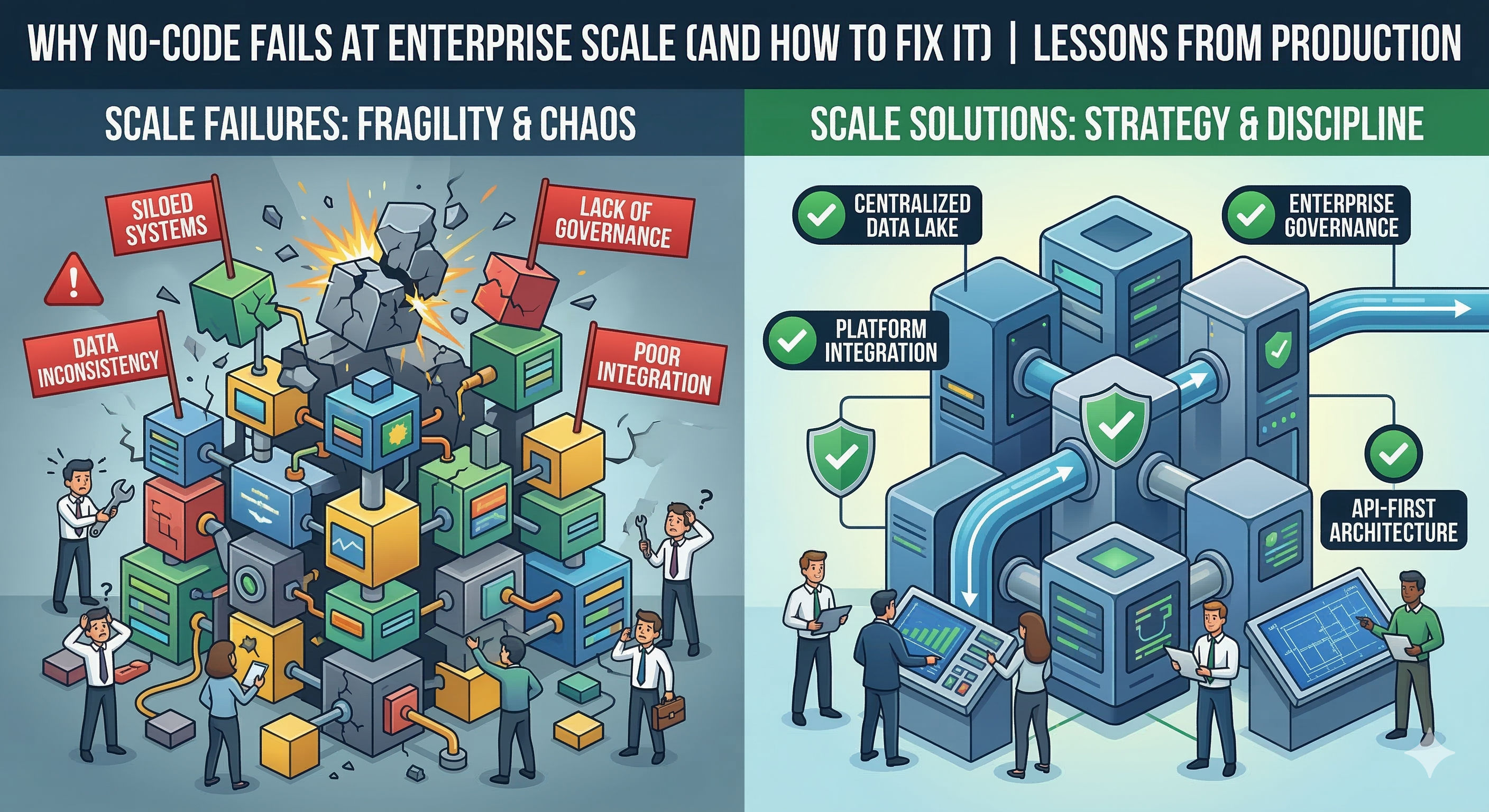
Why No-Code Fails at Enterprise Scale (And How to Fix It)
What actually breaks when you scale no-code beyond team-level tools into enterprise-wide systems — and the architecture decisions that prevent it.
Every enterprise starts the same way with no-code: one team builds a quick app, it works brilliantly, leadership gets excited, and suddenly the whole company wants in. That's when the wheels come off.
No-code platforms have earned their place. They cut IT backlogs, let domain experts build their own tools, and get working software into people's hands in days instead of months. Gartner projects that 70% of new enterprise applications will use no-code or low-code technologies by 2026. The market is racing toward $100 billion by the end of the decade. By every measure, no-code has won the argument.
But winning adoption and winning at scale are two very different things. And the uncomfortable truth that most vendor marketing won't tell you is this: the same speed and simplicity that makes no-code powerful at small scale is exactly what breaks it at enterprise scale.
I've spent years building on no-code platforms — shipping production workflows for enterprise clients across retail, FMCG, and manufacturing. I've seen what works when you're running five workflows. I've also seen what happens when you're running five hundred. They are very different experiences.
Where No-Code Starts Breaking
The cracks don't appear on day one. They appear six months in, when the platform is load-bearing and deeply embedded in how people work. That's what makes this dangerous — by the time you feel the pain, migration is expensive and messy.
The scalability wall is real. No-code platforms abstract away the underlying infrastructure, which is the whole point. But that abstraction comes with hard limits. Database storage caps, workflow execution limits, API call throttling — these constraints barely matter when you're building a leave approval form. They matter enormously when you're processing thousands of sales orders daily or running real-time inventory syncs across multiple warehouses. I've watched platforms that performed beautifully in demos start choking under production volumes that any properly architected system would handle without breaking a sweat.
Integration turns into spaghetti. Enterprise environments don't run on one system. They run on a patchwork of ERPs, CRMs, accounting software, legacy databases, and custom internal tools. No-code platforms typically handle integrations through webhook-based connectors and third-party middleware. This works fine for simple point-to-point connections. But at enterprise scale, you end up with a tangled web of integrations where a single failure can cascade across workflows — and the debugging tools available on most no-code platforms are nowhere near adequate for untangling these messes.
Customization hits a ceiling. The drag-and-drop interface that made development fast in the beginning starts feeling like a cage when business logic gets complex. Conditional workflows with ten branching paths, multi-level approval chains with role-based exceptions, GST-compliant invoice generation with installment support — these are real enterprise requirements. And when the platform's visual builder can't express the logic you need, you're stuck choosing between ugly workarounds that create technical debt or migrating to custom code, which defeats the purpose of going no-code in the first place.
The Governance Problem Nobody Talks About
Here's what I think is actually the bigger issue, and it gets far less attention than scalability: no-code at enterprise scale creates a governance nightmare.
When you empower every department to build their own apps and workflows, you're also creating an explosion of ungoverned tools, data silos, and shadow processes. The average enterprise already has around 670 SaaS applications in its ecosystem, and most IT teams only know about a fraction of them. No-code accelerates this sprawl because the barrier to creation is so low.
I've seen this play out firsthand. Sales builds their own lead tracker. Operations builds a separate order management sheet. Finance builds a custom approval flow. None of these talk to each other. None follow consistent data standards. And when leadership asks for a unified view of the business, someone ends up manually stitching together exports from five different tools.
This isn't a technology failure — it's an architecture failure. And it happens because most organizations adopt no-code as a tool without adopting it as a discipline.
Data fragmentation compounds over time. Every no-code app that stores its own data creates another silo. Without a centralized data architecture, you end up with conflicting versions of truth across departments. Which lead count is correct — the one in the CRM workflow or the one in the sales team's custom tracker? Nobody knows, and reconciliation becomes a full-time job.
Security and compliance gaps emerge quietly. When non-technical users build apps that handle sensitive data — customer information, financial records, employee details — they rarely think about access controls, audit trails, or regulatory compliance. Only 37% of organizations have governance policies covering AI tools, and the number is likely even lower for no-code apps. These aren't malicious oversights. They're the predictable result of giving people powerful building tools without guardrails.
Vendor lock-in becomes a strategic risk. Once you have hundreds of workflows running on a platform, switching costs can reach six figures. Your business logic, data models, and integrations are all expressed in proprietary formats that don't port easily to other platforms or to custom code. You're not just paying a subscription — you're paying a dependency tax that grows every quarter.
How to Fix It (Without Giving Up on No-Code)
I want to be clear: I'm not arguing against no-code. I build on no-code platforms. I've shipped real production systems on them. The technology is sound and getting better every year. The problem isn't the tool — it's how enterprises adopt it.
Here's what I've learned works:
Treat no-code as infrastructure, not experimentation. The moment a no-code app becomes part of a business process that people depend on, it's infrastructure. It needs the same governance, documentation, and architectural oversight as any other enterprise system. That means someone — a product owner, a solutions architect, a platform admin — needs to own the no-code estate the same way someone owns the ERP.
Establish a data architecture before you build. This is the single most impactful thing you can do. Before anyone builds a workflow, decide where master data lives. Define the source of truth for customers, products, orders, and employees. Make sure every no-code app reads from and writes to that shared foundation instead of creating its own local copy. I've been building an internal ERP for an EdTech company, and the first thing we established was a centralized master data module — before a single workflow or dashboard was touched. Everything else connects back to it.
Design for the handoff. Not every process should stay on no-code forever. Some workflows will outgrow the platform. Build with that in mind. Use clean data schemas, document your business logic, and keep your integration layer modular. If the day comes when a workflow needs to move to custom code, the transition should be a migration — not a rebuild from scratch.
Put guardrails on citizen development. Empowering non-technical users to build is great. Letting them build without governance is reckless. Define what types of apps can be built by whom, what data they can access, and what review process they need to go through before going live. The goal isn't to kill the speed advantage of no-code — it's to keep that speed from creating problems that take months to untangle.
Use no-code where it's strongest, custom code where it's necessary. The healthiest enterprise setups I've seen aren't purely no-code or purely custom. They're hybrid. No-code handles internal workflows, approval processes, dashboards, and rapid prototyping. Custom code handles high-volume data processing, complex business logic, customer-facing applications that need pixel-perfect control, and integrations that require fine-grained error handling. Knowing where to draw that line — and being honest about when you've crossed it — is the real skill.
The Bottom Line
No-code isn't failing at enterprise scale because the platforms aren't good enough. It's failing because enterprises are scaling it like a tool when they need to scale it like a system.
The platforms will keep getting better. AI-assisted building is already making no-code faster and more capable. But the fundamental challenges — data architecture, governance, integration complexity, and vendor dependency — won't be solved by better drag-and-drop interfaces. They'll be solved by teams that treat no-code adoption with the same strategic rigor they'd apply to any enterprise technology decision.
Build fast, but build deliberately. That's how no-code works at scale.