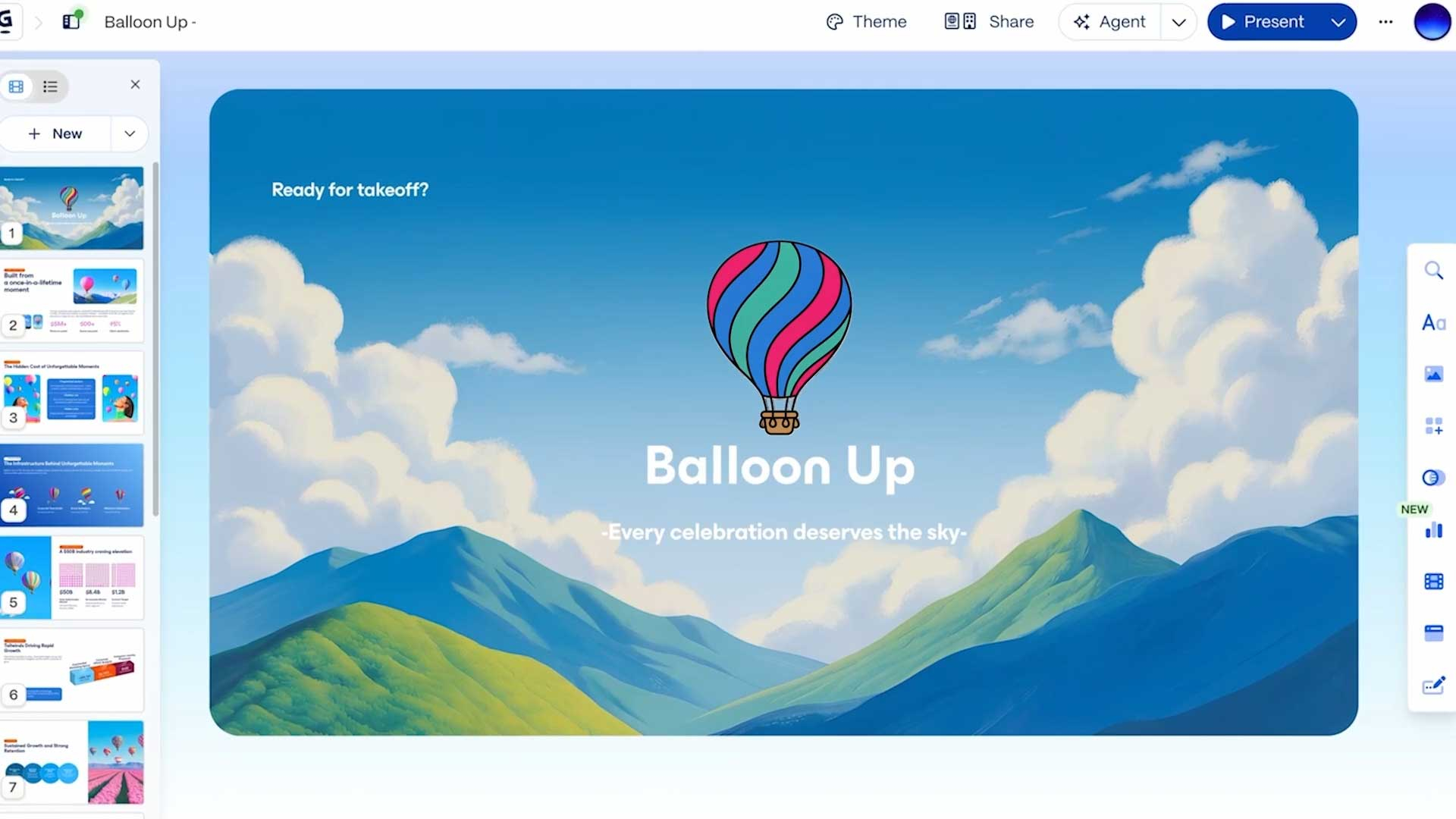
From PowerPoint to Gamma: How AI-Native Tools Are Making Presentations Obsolete
Gamma just launched Imagine, hit 100 million users, and crossed $100M in ARR. Figma lets you present clickable webpages. Meanwhile, PowerPoint is still asking you to pick a template. What happened?
Gamma just launched Gamma Imagine — an AI-native design tool that generates logos, infographics, social graphics, and branded assets from text prompts. They've hit nearly 100 million users, crossed $100 million in ARR, and are valued at $2.1 billion. Meanwhile, PowerPoint is still asking you to pick a template and manually drag text boxes. Something has clearly shifted.
Yesterday — March 17, 2026 — Gamma announced its biggest release to date. Gamma Imagine is a standalone visual design tool built directly into the Gamma platform that lets you create on-brand design assets using natural language. Describe what you want, and it generates logos, infographics, diagrams, interactive charts, and social media graphics — all automatically styled to your brand colours and visual identity. It integrates with ChatGPT, Claude, Make, Zapier, Atlassian, n8n, and Superhuman Go, meaning you can now generate Gamma presentations directly from the AI assistants and workflow tools your team already uses.
This isn't just a product update. It's a signal that the presentation category — one of the most entrenched software markets in the world — is being fundamentally rewritten. And Microsoft, despite being the incumbent that defined the category, is watching the rewrite happen from the sidelines.
How We Got Here
For thirty years, Microsoft PowerPoint owned presentations. Not because it was the best tool for communicating ideas — but because it was everywhere. It shipped with Office. It was what your boss used. It was the format clients expected. The file format itself, .pptx, became the default language of business communication.
Then three things happened simultaneously.
Cloud-native collaboration became non-negotiable. Google Slides proved that presentations didn't need to be files saved on desktops. Real-time co-editing, automatic saving, and sharing via links — these weren't premium features. They became baseline expectations. PowerPoint added collaboration features eventually, but they always felt bolted on rather than native. The experience of collaborating in PowerPoint, even today, still involves version conflicts, sync delays, and the eternal "which version is the latest?" problem that Google Slides solved years ago.
Design tools started eating the presentation layer. Figma launched Slides at Config 2024 after noticing that users were already creating 35,000 presentations inside Figma design files between June 2023 and June 2024 — without any dedicated presentation features. People were building pitch decks in a design tool because the design quality was better than what PowerPoint offered. Figma Slides now lets you embed interactive prototypes, run live polls, toggle between simplified and designer modes, and collaborate in real time with visible cursors. You can build a clickable webpage prototype in Figma and present it as a slide — something PowerPoint fundamentally cannot do.
Canva took a different angle entirely — democratising design for non-designers. Drag-and-drop templates, brand kits, one-click resizing for different formats. For the marketing manager who needs a deck that looks professional in 20 minutes, Canva became the answer. Not because it's more powerful than PowerPoint, but because the gap between "open the tool" and "share something that looks good" collapsed to almost nothing.
AI made the blank slide obsolete. This is the shift that matters most. Gamma, Beautiful.ai, Tome, SlidesAI — these tools don't start with a blank canvas. They start with a prompt. You describe what you want to communicate, and the AI generates a complete, structured, visually polished presentation. Not a rough outline. Not bullet points you then format manually. A finished artifact with layout, imagery, content, and design coherence.
Gamma does this in under 60 seconds. And with the Gamma 3.0 launch last September introducing the Gamma Agent — an AI design partner that researches the web, refines content, restyles entire decks, and takes feedback in natural language — the gap between "I have an idea" and "I have a shareable presentation" shrank to a single conversation.
What Gamma Imagine Actually Changes
Gamma started as an AI presentation maker. Then it expanded into documents and one-click websites. Now, with Gamma Imagine, it's stepping into the full visual design category — directly challenging Canva and Adobe on their turf.
Here's what Gamma Imagine does:
- AI Illustrations — generate and revise branded logos, marketing assets, and social graphics using natural language prompts
- AI Infographics — create on-brand infographics and diagrams from a text description, usable standalone or inside a presentation
- Smart Charts — build interactive data visualisations (bar charts, scatter plots, funnels, heatmaps) that automatically inherit brand styling
- AI-native remixable templates — start with any previous Gamma creation or one of 100+ new professionally designed templates, describe changes in plain language, and get a fresh version instantly
- Reference image matching — upload a style reference and the tool matches that aesthetic across your entire creation
The key insight is that Gamma Imagine is AI-native at its core — not AI bolted onto existing design workflows. Legacy tools responded to the AI wave by adding AI features to their existing interfaces. Gamma built the interface around AI from the beginning. The difference in experience is noticeable.
And the enterprise integration layer is significant. Being able to generate Gamma content from inside ChatGPT, Claude, or your automation workflows via Zapier and Make means presentations can now be created programmatically — triggered by events, populated with real data, styled to brand guidelines, and shared automatically. That's a fundamentally different paradigm from "open PowerPoint and start dragging text boxes."
Where Microsoft Went Wrong (And Where It Didn't)
Here's the nuanced take: Microsoft didn't lose the presentation market. It lost the presentation moment.
PowerPoint still dominates in raw market numbers. Over 56,000 companies actively use it. It's embedded in Microsoft 365, which is embedded in enterprise IT. The file format is universal. For compliance-heavy, template-locked, enterprise-grade presentations that need to integrate with SharePoint, Teams, and the broader Microsoft ecosystem — PowerPoint isn't going anywhere.
But Microsoft lost the moment where someone has an idea and needs to turn it into something shareable, fast. That moment — the pitch deck before the investor meeting, the project update for the Monday standup, the sales one-pager for the prospect call — increasingly doesn't start with PowerPoint. It starts with Gamma, Canva, or even Figma.
Where Microsoft went wrong:
Copilot was too little, too late for presentations. Microsoft added AI through Copilot in PowerPoint, but it fundamentally keeps you inside the old paradigm — you still work slide by slide, you still manually adjust layouts, you still think in terms of templates and formatting. Copilot helps you do PowerPoint things faster. Gamma removes the need to do PowerPoint things at all.
The collaboration experience never caught up to cloud-native. Google Slides showed what real-time, zero-friction collaboration looked like a decade ago. PowerPoint's collaboration still feels like an afterthought — file conflicts, confusing version histories, and the persistent annoyance of "this file is being edited by someone else." For teams that live in the cloud, this friction compounds.
The design quality stagnated. PowerPoint templates look like PowerPoint templates. Everyone recognises them. The "professional" aesthetic of PowerPoint hasn't meaningfully evolved, while Gamma, Canva, and Figma are producing output that looks like it was designed by an actual designer. When a $10/month AI tool produces a more visually compelling deck than a $22/month Microsoft 365 subscription, the value equation shifts.
The format itself became a limitation. The 16:9 slide format made sense for projectors. It makes less sense for sharing on screens, embedding in web pages, or reading on mobile devices. Gamma's card-based, scrollable format is responsive by default. Figma lets you present interactive prototypes. The rigid slide format that defined PowerPoint is now a constraint, not an advantage.
Where Microsoft is still secure:
Enterprise lock-in is real. If your company runs on Microsoft 365, switching presentation tools means fighting IT policy, procurement workflows, and user habits. PowerPoint won't die in the enterprise — it will slowly become the "formal" presentation tool while cloud-native alternatives handle the day-to-day.
Regulatory and compliance use cases. Some industries require specific file formats, audit trails, and template controls that Microsoft 365 provides. Healthcare, finance, and government won't move to Gamma anytime soon.
The ecosystem advantage. PowerPoint integrates with Excel, Word, Teams, SharePoint, and OneDrive in ways that standalone tools can't easily replicate. For organisations deeply invested in the Microsoft stack, this integration gravity is powerful.
The Bigger Picture: Presentations Are Becoming a Feature, Not a Product
What's really happening isn't just Gamma versus PowerPoint. It's that "presentations" as a standalone product category are dissolving.
Figma lets you present design prototypes as interactive slides. Gamma lets you publish a presentation as a website with one click. Notion lets you share structured documents that serve the same purpose as a deck. Claude and ChatGPT can generate presentation outlines that feed directly into Gamma via API.
The artifact that used to be "a PowerPoint file" is becoming a fluid, multi-format output — sometimes a deck, sometimes a webpage, sometimes a document, sometimes a social graphic. Gamma Imagine's expansion into infographics, charts, and social assets is the clearest expression of this trend. The future isn't "better slide software." It's a tool that takes your idea and outputs it in whatever format your audience needs.
For Microsoft, this is the real strategic threat — not that someone builds a better PowerPoint, but that the very concept of opening a presentation application becomes unnecessary. When an AI agent can research your topic, generate a branded deck, publish it as a shareable link, and create social graphics from the same content — all from a single prompt — the application layer becomes invisible.
What This Means If You're Choosing Tools Today
If you need speed and modern design: Gamma. It's not close. The AI generation quality, the card-based format, and the new Imagine features make it the fastest path from idea to shareable output. The free tier gives you 400 AI credits — roughly 10 full presentations — to test it before committing.
If your team lives in Figma: Figma Slides. The ability to embed interactive prototypes, use the full Figma design toolkit, and collaborate with real-time cursors makes it the best choice for design-forward teams.
If you need enterprise compliance and Microsoft ecosystem integration: PowerPoint. It's not exciting, but it's the safe choice for regulated industries and large organisations with Microsoft 365 standardised across the company.
If you want design quality without design skills: Canva. The template library and drag-and-drop interface remain the most accessible entry point for non-designers.
If you want AI-generated presentations inside your existing workflow: Gamma with its new integrations (ChatGPT, Claude, Zapier, Make) lets you trigger presentation creation programmatically — which is a workflow no other tool currently matches.
The Bottom Line
Gamma Imagine's launch isn't just a product announcement. It's a marker for where the presentation category has arrived in 2026: AI-native, multi-format, brand-aware, and increasingly invisible as a standalone application.
Microsoft secured its market through enterprise lock-in and ecosystem gravity. That's not going away. But the creative energy, the user growth, and the innovation are happening elsewhere — at Gamma, Figma, Canva, and a new generation of tools that treat presentations not as a format to build inside, but as an output to generate from ideas.
PowerPoint isn't dead. But for a growing number of users — now approaching 100 million on Gamma alone — it's already irrelevant.
The best presentation tool in 2026 is the one you never have to open. You just describe what you want, and it exists.