Agentic AI in the Real World: Beyond the Demo
What it actually takes to move AI agents from impressive demos to production systems that handle real business operations.
Every vendor demo looks flawless. The agent reasons, plans, executes — and the room applauds. Then you deploy it into your actual enterprise environment, and the applause stops pretty quickly.
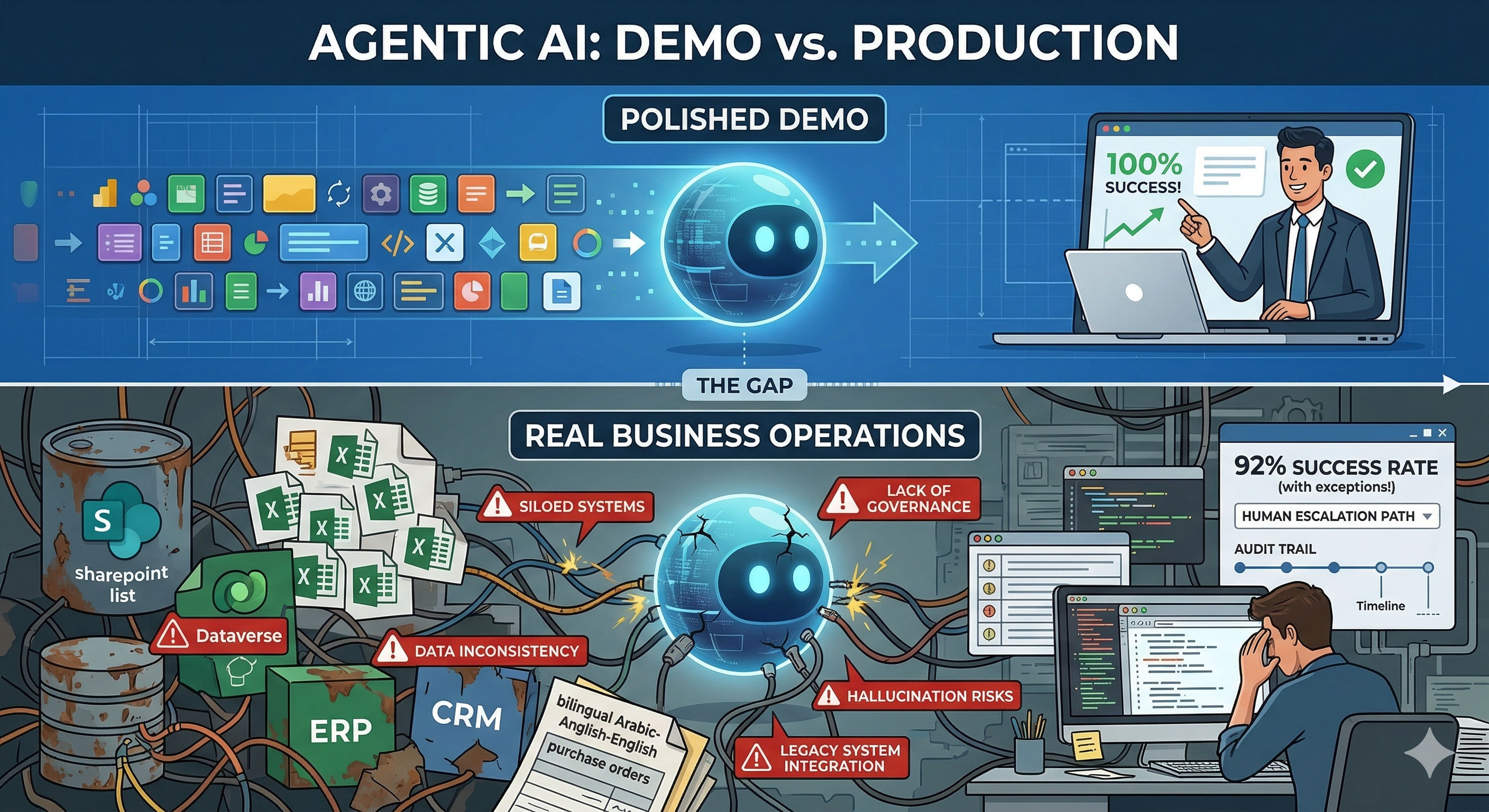
If you've spent any time in enterprise software circles over the past eighteen months, you've heard the pitch: autonomous AI agents that plan, reason, and execute multi-step workflows without constant human steering. The promise is real. The technology genuinely works — in controlled conditions. But the gap between a polished demo and a production deployment is where most agentic projects go to die.
And the data backs this up. Gartner predicts that over 40% of agentic AI projects will be cancelled by the end of 2027, largely due to escalating costs, unclear business value, and inadequate risk controls. A RAND Corporation study found that AI projects fail at nearly double the rate of traditional IT projects — with over 80% never reaching meaningful production use.
So what's actually going wrong? And more importantly, what separates the teams that ship from the teams that shelve?
The Demo-to-Production Chasm
Here's what I've observed firsthand, and what the research consistently confirms: the failure isn't in the AI. It's in everything around it.
The messy reality of enterprise data. Agentic systems need clean, contextual, accessible data to make decisions. Most enterprises don't have that. According to Deloitte's 2025 Emerging Technology Trends study, nearly half of organizations cited data searchability and reusability as their top challenges when deploying AI automation. Your agent can be brilliant in reasoning, but if it's pulling from fragmented databases with inconsistent schemas and stale records, it will hallucinate its way into expensive mistakes.
I've lived this firsthand, building an AI-powered SKU Matching system for enterprise clients in the Gulf region. The models worked well in testing. But in production, we were dealing with bilingual Arabic-English purchase orders, handwritten scanned delivery orders, and ERP-generated documents that all followed different formatting conventions. The "data problem" isn't abstract — it's a specific, grinding, document-by-document reality.
Legacy systems weren't designed for agents. Most agents still rely on APIs and conventional data pipelines to interact with enterprise systems, creating bottlenecks that limit autonomous operation. If your company runs on a patchwork of ERPs, CRMs, and custom internal tools — which is most companies — your agent needs to navigate all of that. And "navigate" is generous. It's more like "wrestle with."
Over-scoped ambitions kill projects. The teams that succeed don't try to automate an entire end-to-end workflow on day one. They pick a single, clearly defined business problem with measurable outcomes, prove it works, and expand from there. The ones that fail? They attempt to boil the ocean — starting with "let's build an AI agent that handles all of customer operations" instead of "let's build an agent that triages incoming support tickets and routes them correctly."
What Actually Works in Production
After building workflows that live in production — from Quote-to-Cash automation to AI order management systems — I've noticed a consistent pattern among the deployments that survive first contact with reality.
Start narrow, stay honest about error tolerance. The successful implementations — and what Amazon's own evaluation framework for agentic systems confirms — share a common trait: they target tasks where a 3-15% error rate is acceptable and where the business value clearly justifies the investment. Invoice processing, document classification, order routing — these are the unglamorous workhorses where agents actually deliver ROI.
Design for failure, not just success. Production environments are messy. Data formats change, systems go down, edge cases show up daily. The best agentic systems have graceful degradation built in from the start — circuit breakers, human escalation paths, and comprehensive audit trails. An agent that fails silently is worse than no agent at all.
Treat agents as collaborators, not replacements. Klarna learned this the hard way. They initially promoted their AI agent handling 80% of customer interactions as a win. But after customer complaints about the lack of human fallback, they reversed course and focused on augmenting human agents instead. The lesson? Full automation is seductive on paper and brittle in practice. The best deployments choreograph AI and human effort — agents handle the routine, humans handle the exceptions.
Invest in the boring stuff. Data governance. Workflow redesign. Evaluation frameworks. Monitoring. None of this is exciting at a conference keynote, but McKinsey's 2025 State of AI Survey found that organizations reporting significant ROI from AI projects were twice as likely to have redesigned their end-to-end workflows before deploying AI. You don't bolt an agent onto a broken process and expect it to fix itself.
The Agentwashing Problem
There's another issue that doesn't get discussed enough: much of what's being marketed as "agentic AI" is simply rebranded chatbots, RPA bots, or AI assistants. Gartner calls it agentwashing — and it's rampant.
A genuine agentic system can reason, plan multi-step actions, invoke tools, monitor its own progress, and adapt when things go sideways. An AI assistant that responds to prompts and needs human input at every step is not an agent, no matter what the sales deck says. The distinction matters because it shapes expectations. When a leadership team buys "agentic AI" and receives a slightly smarter chatbot, the resulting disappointment poisons the well for legitimate agentic projects that follow.
Where Agentic AI Is Headed
Despite the high failure rate and the hype, the trajectory is clear. Gartner predicts that 40% of enterprise applications will include task-specific AI agents by the end of 2026, up from less than 5% in early 2025. Spending is accelerating — mid-80s percent of leaders expect to increase their AI agent budgets in the coming year. And the agentic AI market, estimated at $7-9 billion in 2025 revenue, is projected to grow at 40%+ annually over the next decade.
The real competitive gap won't be between organizations that adopt agentic AI and those that don't. It will be between organizations that industrialize a small number of high-value use cases with proper data foundations, governance, and workflow redesign — and those that stay trapped in an endless cycle of proofs of concept.
From what I'm seeing on the ground, the winners share three traits:
They start with the workflow, not the technology. Before choosing a framework or model, they map the process they want to improve, identify where human effort is wasted, and define what "success" looks like in hard numbers.
They treat data readiness as a prerequisite, not an afterthought. Clean, structured, contextual data isn't a nice-to-have. It's the difference between an agent that works and an agent that hallucinates.
They build for accountability. Every agent action is logged, auditable, and reversible. Human oversight isn't a crutch — it's a design principle.
The Bottom Line
Agentic AI is not vaporware. The technology works. But technology was never the hard part. The hard part is the same thing it's always been in enterprise software: getting your data right, redesigning your processes around new capabilities instead of bolting automation onto broken workflows, and having the discipline to start small and prove value before scaling.
The demo is the easy part. Production is where the real work begins.